What's Actually in Maui Tap Water?
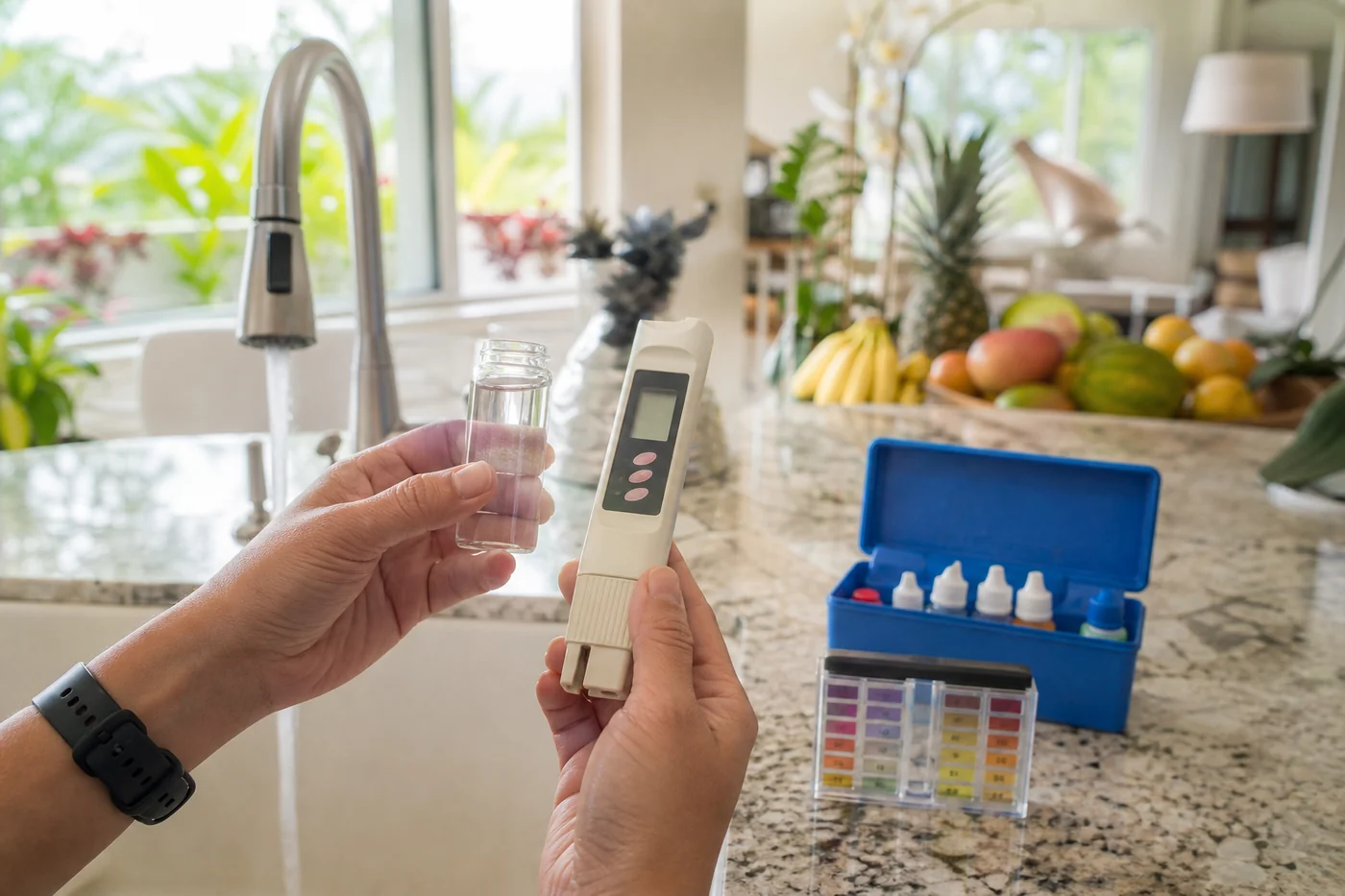
Maui Water Filtration Co. starts every relationship the same way: with a free water test at your home, anywhere on Maui. The honest truth is that Maui's municipal water generally meets federal and state drinking water standards — the Maui Department of Water Supply publishes annual water quality reports confirming it. So why test? Because meeting standards and being the water you want in your home are two different things, and because water on Maui varies enormously depending on where you live.
Central and South Maui homes — Kahului, Wailuku, Kihei, Paia — draw primarily from groundwater sources, where hardness commonly measures between 51 and 171 mg/L as calcium carbonate. Anything above about 75 mg/L is considered hard water, which is why so many Kihei and Kahului homeowners see white scale on fixtures, spotted glassware, and shortened water heater lifespans. Upcountry communities like Kula, Makawao and Haiku are served largely by surface water that runs soft (roughly 17–69 mg/L) but is treated with chlorine that many residents can taste. West Maui's supply is a mix, and after the 2023 wildfires, many West Maui families simply want independent confirmation of what's in their water before they drink it.
A free test tells you which of these situations applies to your house — so you never buy equipment you don't need.
What We Test For
- Hardness (calcium & magnesium) — the mineral load that causes scale buildup, soap scum, and appliance wear
- Chlorine / chloramine residual — the disinfectant taste and odor most people notice in a glass of tap water
- Total dissolved solids (TDS) — the overall mineral and salt content of your water
- pH — acidity or alkalinity, which affects taste and plumbing over time
- Iron and visible sediment — staining and discoloration issues
- Lab referral for advanced concerns — for anything an in-home screen can't measure (lead, VOCs, bacteria), we'll tell you plainly and point you to a certified laboratory rather than guess
How the Free Test Works
- Book your visit. Fill out the form and pick a time. Most tests are scheduled within a few days, anywhere on the island.
- 15–20 minutes at your tap. We sample cold water from your kitchen tap and an outside spigot, run the panel on the spot, and record everything.
- Plain-language walkthrough. You get the numbers, what they mean for your home specifically, and — only if the results call for it — the options that address them, with real pricing.
When Testing Matters Most on Maui
After moving into a new home. Water character changes street to street depending on the source feeding your neighborhood. What was true at your last house in Wailuku may not be true in Kihei.
Before buying a filtration system anywhere. Big-box and online sellers size systems blind. A $6,000 whole-house system built for heavy chlorine is the wrong buy if your actual problem is hardness — and vice versa. Test first, buy once.
If you're on West Maui and still uneasy. Following the 2023 wildfires, parts of West Maui and Upper Kula spent months under water advisories. The county lifted them after extensive testing, but a 2026 university study of hundreds of Maui homes found many residents still don't fully trust their tap. If that's you, an independent test is the fastest path to peace of mind — whatever the result.
If appliances keep failing early. Scale from hard water is the quiet killer of water heaters, dishwashers, and coffee equipment in Central and South Maui. A hardness number tells you whether a softener would pay for itself.
What Happens After the Test?
Nothing, unless you want it to. You keep your results either way. If your water shows something worth fixing, we'll quote the appropriate fix — typically a reverse osmosis system for drinking water, a whole-house carbon system for chlorine, taste and odor, or a softener or conditioner for hardness — with installation usually completed in a single visit.