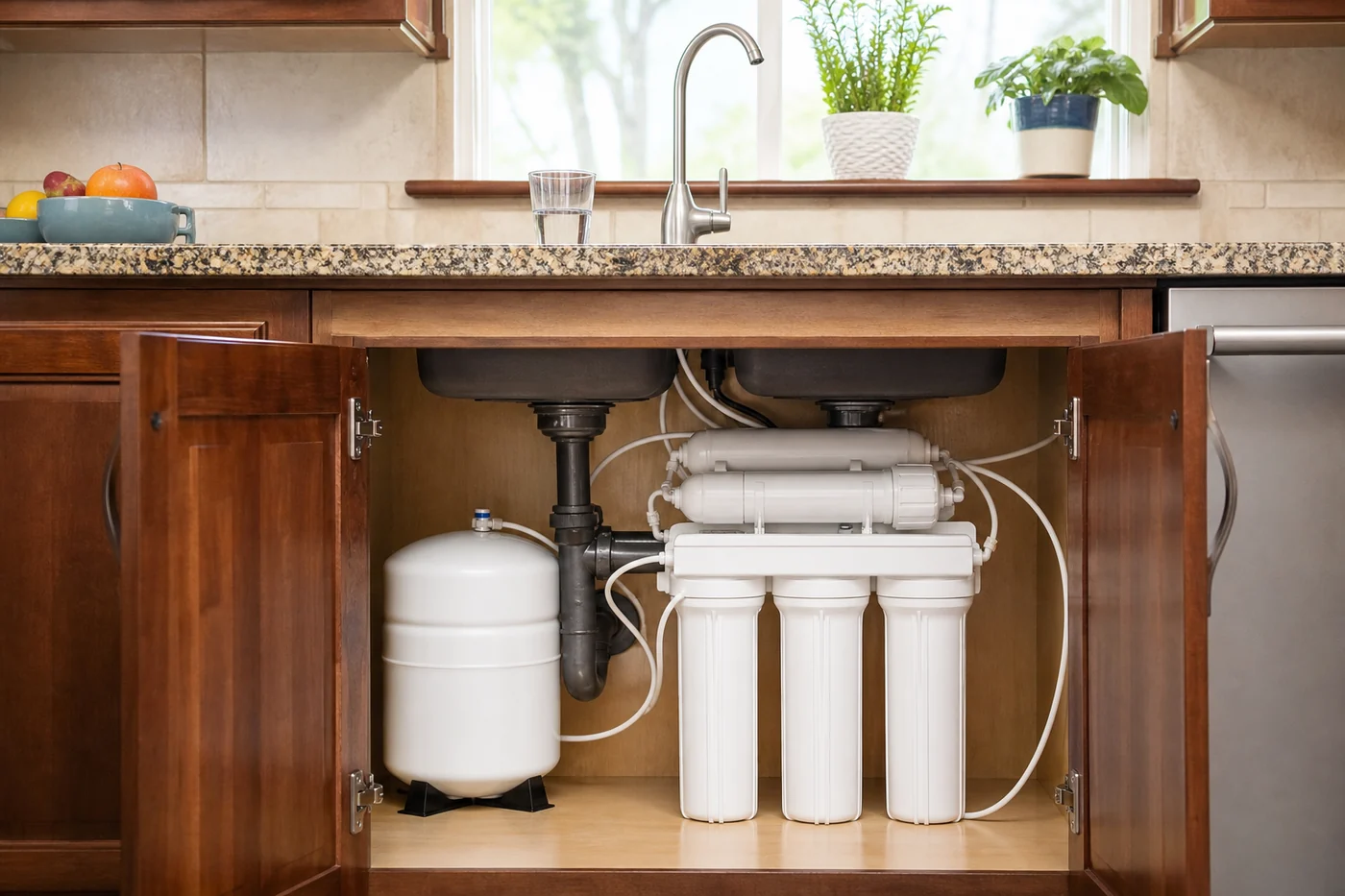
What Reverse Osmosis Does
Reverse osmosis (RO) forces water through a semi-permeable membrane with pores small enough to reject the vast majority of dissolved solids — minerals, salts, metals, and a long list of contaminants that carbon filtration alone can't touch. A multi-stage under-sink RO system combines sediment and carbon pre-filters, the RO membrane itself, and a polishing post-filter, delivering water to a dedicated faucet at your kitchen sink. The result is drinking and cooking water measured in single-digit or low double-digit TDS — comparable to premium bottled water, without the plastic, the hauling, or the Costco run.
On Maui the case for RO is unusually strong. Central and South Maui groundwater carries a heavy dissolved mineral load — the same 51–171 mg/L hardness that scales your fixtures also flavors your drinking water. Upcountry's soft surface water carries chlorine that survives into your glass. And across West Maui, where a 2026 university study documented a lasting surge in home water treatment after the 2023 fires, an RO tap is the single most direct answer to the question "can I just have water I completely trust for drinking?" Whatever your zone, RO gives you a dedicated tap you never have to think about.
What an RO System Removes
- Dissolved solids (TDS) — typically 90%+ reduction, transforming taste
- Hardness minerals in your drinking water — no more film on top of your coffee
- Chlorine and chloramine — polished out by the carbon stages
- Lead and heavy metals — RO membranes are among the most effective residential barriers
- Sodium — including the small amount a water softener adds, which is why RO pairs perfectly with a softener
Options and Pricing
| System | Best For | Typical Investment |
|---|---|---|
| Standard 4–5 stage under-sink RO | Most kitchens; tank stores 2–3 gallons ready to pour | $500–$900 installed |
| High-output / tankless RO | Big households, entertainers, coffee obsessives; faster flow, smaller footprint under the sink | $900–$1,500 installed |
| RO + remineralization stage | Those who prefer mineral taste profile restored after filtration | +$100–$200 |
Every quote includes the dedicated faucet, connection to your fridge/ice maker where practical, and the first year's filter schedule in writing.
Installed in 2–3 Hours
- Free water test. We measure your incoming TDS and hardness so you can see the before/after for yourself — and so we know whether pre-treatment will extend your membrane's life.
- Under-sink installation, 2–3 hours. Licensed local professionals mount the system, install the dedicated faucet, and pressure-test every connection before leaving.
- Annual filter service. Pre- and post-filters change roughly yearly, the membrane every 2–4 years depending on your water. Our on-island service plan handles it — no shipping filters to yourself, no forgetting which cartridge goes where.
RO and the Rest of Your Water
RO is a drinking-water solution, sized for the tap you drink and cook from — it isn't meant to treat every fixture in the house. If chlorine taste and odor bother you in the shower too, look at a whole-house carbon system. If scale is wrecking your fixtures and water heater in Kihei or Kahului, that's a softener conversation. The free water test sorts out which combination actually fits your home — frequently the answer is simpler and cheaper than people expect.