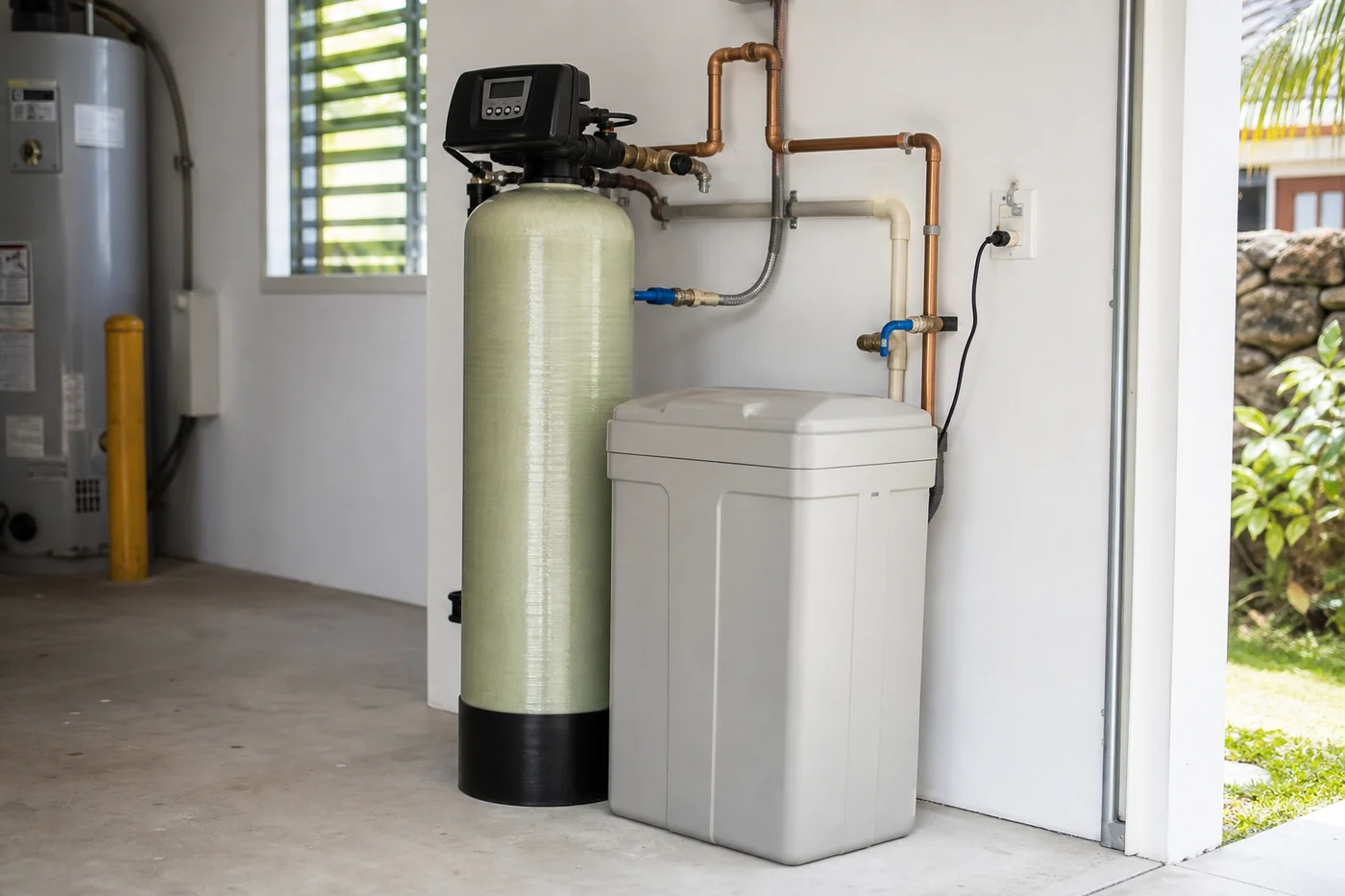
Hard Water Is a Central & South Maui Problem
Water hardness on Maui isn't uniform — it's a tale of two islands. Upcountry surface water is naturally soft (roughly 17–69 mg/L as calcium carbonate). But Central and South Maui — Kahului, Wailuku, Kihei, Paia — draw on groundwater where hardness commonly measures 51 to 171 mg/L. Water above 75 mg/L is classified as hard, and at the upper end of that range you're solidly into the territory where scale becomes a household tax: crusted faucet aerators, spotted glassware, cloudy shower doors, stiff laundry, and — the expensive one — mineral scale quietly coating the inside of your water heater until it fails years early.
If that list sounds like your house, you don't need to be convinced hard water is real. The question is which fix fits: a traditional salt-based softener or a salt-free conditioner. We install both, and the honest answer differs by household.
Softener vs. Salt-Free Conditioner
| Salt-Based Softener | Salt-Free Conditioner | |
|---|---|---|
| How it works | Ion exchange — removes calcium and magnesium from the water entirely | Template-assisted crystallization — minerals stay in the water but are converted to a form that resists sticking to surfaces |
| Scale prevention | Complete — water is actually soft | Substantial scale reduction, but water still measures hard |
| Feel & soap | Silky feel, lather improves dramatically, soap use drops | Feel largely unchanged |
| Maintenance | Salt refills (easy but recurring); periodic resin service | Near-zero maintenance; media swap every few years |
| Water use | Regenerates with some water use | No regeneration, no wastewater |
| Typical investment | $1,500–$5,000 installed | $1,500–$4,000 installed |
Rule of thumb: households that want the full soft-water experience — the feel, the lather, spotless glass — choose the traditional softener. Households that mainly want to stop appliance damage with zero upkeep, or that are wary of salt handling and discharge, choose the conditioner. Both beat doing nothing by a wide margin in Kihei-hardness water.
What Softening Saves You
- Water heater life — scale is the leading avoidable killer of water heaters in hard-water zones; even a few millimeters of scale forces the element to work measurably harder
- Appliances — dishwashers, washing machines, and ice makers all live longer without mineral buildup
- Fixtures and glass — no more vinegar-soaking showerheads or scrubbing white crust off tile
- Soap and detergent — soft water cuts soap use noticeably; lather works the way it's supposed to
- Plumbing — scale narrows pipes and restricts flow over years; softening halts the process
Installation: 3–5 Hours
- Free hardness test. We measure your actual grains-per-gallon — Kihei and Kahului numbers vary meaningfully by neighborhood — and size the system to your household, not a national average.
- Install by licensed local professionals, 3–5 hours. Softeners need a drain line and, in some homes, a loop — slightly more involved than a filter install, still done in one visit.
- Dial-in and walkthrough. We set regeneration to match your usage (efficient, not wasteful), show you the salt routine if applicable, and put the service schedule in writing.